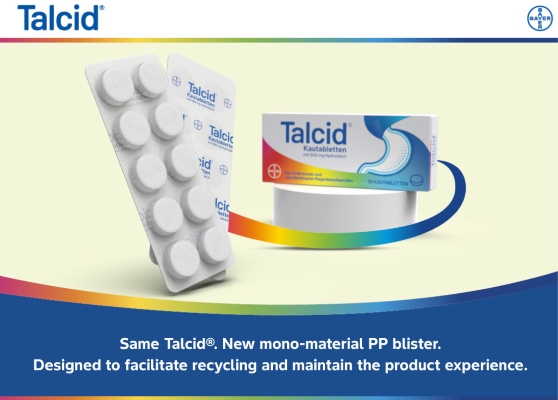
Bayer has launched a mono-material polypropylene (mono-PP) blister for its Talcid antacid in Germany, replacing a multi-material pack with a single-material design aimed at supporting recycling where the necessary collection, sorting and recycling infrastructure exists.
The German rollout follows the blister’s initial launch in Slovenia in late 2025 and marks a significant step in Bayer’s efforts to simplify packaging structures while maintaining product protection, safety and consumer usability.
Germany is Talcid’s largest European market, accounting for about 75% of the product’s European sales. Bayer plans to roll out the mono-PP blister in 11 additional European markets during 2026–2027.
The packaging shift comes amid growing consumer and regulatory attention on recyclable packaging. McKinsey’s 2025 global consumer packaging survey found that recyclability remains among the sustainability attributes consumers value most.
Traditional blister packs can contain multiple materials, potentially making sorting and recycling more complex. Talcid’s new blister uses polypropylene alone, creating a mono-material structure designed to simplify compatibility with recycling processes while meeting the protection and quality requirements of a consumer healthcare product.
The blister has received RecyClass Design for Recycling certification, achieving the highest Recyclability Class A rating and a recyclable plastic content score of 98.86%.
The certification applies to the packaging design under RecyClass Design for Recycling criteria. Actual recycling remains dependent on local collection, sorting and recycling infrastructure and can vary by market.
The change affects only the packaging. Talcid’s formulation, indication, safety profile, quality and usage instructions remain unchanged.
The Talcid launch expands Bayer’s work on mono-material blister technology.
In 2024, Bayer introduced a PVC-free polyethylene terephthalate (PET) one-material blister for Aleve in the Netherlands. While the Talcid and Aleve packs use different materials, both apply the same basic approach: simplifying packaging structures without compromising product protection or usability.
“The promise of this mono-material polypropylene design is that it can improve compatibility with recycling processes where appropriate systems exist, while continuing to provide a strong consumer experience,” said Chris Padain, Vice President and Global Head of Design, Packaging, Product Experience & Sustainability for Bayer’s Consumer Health division.
“Its push-through performance supports intuitive use, while the mono-material structure simplifies the packaging design. This is the kind of practical, scalable innovation that can make a meaningful difference across our portfolio.”
The Talcid blister forms part of Bayer Consumer Health’s wider packaging strategy, which includes improving packaging compatibility with recycling processes where suitable infrastructure exists, expanding reusable packaging formats, incorporating recycled content where appropriate and reducing unnecessary packaging materials.
The new Talcid blister was developed through collaboration across the packaging value chain, combining material expertise and manufacturing capabilities with Bayer’s product, quality and regulatory requirements.
“Developing a mono-material blister for consumer health products requires the material, manufacturing process and product-protection requirements to work together,” said Martin Rank, Head of Sales & Marketing at Etimex Primary Packaging. “Our collaboration with Bayer has turned that technical challenge into a scalable PURELAY PP mono-material blister solution for Talcid.”
Talcid will continue to be manufactured and supplied from Bayer’s site in Bitterfeld, Germany.
“Germany is Talcid’s largest European market, making it a natural next step for the new blister,” said Tobias Boldt, Consumer Health Cluster Lead for Germany and Austria. “This launch connects Talcid’s strong German heritage with a packaging innovation that is planned to reach consumers across more European markets.”