Leaders from science, policy, industry, and investment came together in New Delhi to examine how alignment across the biotechnology value chain can turn innovation into outcomes at scale
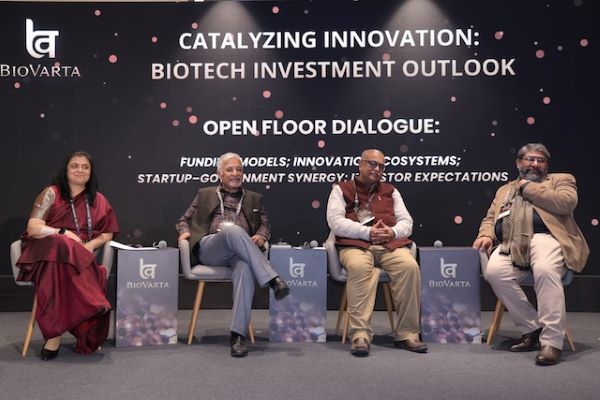
BioVarta 2025 was conceived as a purposeful dialogue on the Indian biotechnology sector. Organized by Premas Biotech, the gathering brought together leaders from science, healthcare, policy, manufacturing, investment, and entrepreneurship, each representing a distinct stage of the innovation journey.
At its core, BioVarta was built on a clear premise: scientific discovery alone does not create impact. Innovation advances only when discovery is aligned with manufacturing readiness, regulatory pathways, capital support, and clinical application. Throughout the day, discussions explored how these elements interact, where alignment breaks down, and why closing the loop between discovery and deployment is essential for delivering outcomes at scale.
Held in New Delhi on December 13, 2025, the day-long dialogue unfolded through a structured series of conversations spanning translation, frontier innovation, scale-up, investment, and clinical development. While participants came from across the biotechnology value chain, a shared understanding quickly emerged—innovation becomes real only when the ecosystem is designed to enable it.
Welcoming the participants, Dr. Prabuddha Kundu, Co-Founder and Managing Director of Premas Biotech, reflected on the evolution of India’s biotechnology sector. He emphasized the growing need for tighter integration between discovery, manufacturing, regulation, and capital so that innovation can move efficiently from laboratories to patients and populations.
The opening discussions focused on translation—where discovery meets impact. Prof. N. K. Arora, Chairperson of India’s National Immunization Technical Advisory Group and a senior public health leader, underscored that scientific excellence gains meaning only when aligned with societal and healthcare outcomes. He highlighted the importance of strong institutions, proactive regulator engagement, and GMP-aligned systems that enable innovations to transition from research environments into real-world use.
Adding a macroeconomic perspective, Dr. Prasenjit K. Basu, Founder and Chief Economist at REAL-economics.com, spoke about the long-term drivers of innovation competitiveness. He noted that sustained leadership depends not only on scientific depth, but also on talent flows, global positioning, and enduring innovation infrastructure. Retaining scientific capability and aligning national ambition with ecosystem capacity, he argued, are critical to long-term success.
From the perspective of academic translation and entrepreneurship, Dr. Ashutosh Chilkoti, Professor of Biomedical Engineering at Duke University, discussed the challenges of moving research from labs to applications. The conversation highlighted the importance of translational platforms, shared infrastructure, and supportive ecosystems that lower barriers for early-stage innovation and allow long-horizon science to mature into scalable products.
Innovation was also examined through the lens of the enabling value chain. T. L. Satyaprakash, Joint Secretary at the Department of Pharmaceuticals, noted that scale-up is often constrained not by a lack of ideas, but by system readiness. He emphasized manufacturing preparedness, cost structures, and process design, highlighting the role of automation, digitalisation, and optimized workflows in enabling GMP-compliant, economically viable scale-up. His reflections reinforced that innovation requires coordinated support across discovery, manufacturing, and market realities.
The dialogue then expanded to frontier innovation and next-generation platforms. Drawing on her experience in national public health and disease surveillance, Dr. Nivedita Gupta, Scientist-G and Head of the Communicable Diseases Division at ICMR, described innovation as the ability to anticipate emerging challenges and build readiness in advance. She emphasized coordinated approaches, standardized protocols, and integrated frameworks—such as One Health—as essential for faster and more reliable responses across surveillance, diagnostics, and preparedness.
Prof. Samir Mitragotri, Hiller Professor and Core Faculty at Harvard University and the Wyss Institute, reinforced that innovation is incomplete until outcomes are delivered. Drawing from his experience translating research into clinical and commercial products, he stressed the importance of designing science with scalability, manufacturability, and simplicity in mind. Academic innovation, he noted, becomes a powerful engine for impact when paired with rigorous evaluation and purposeful translation pathways.
From a systems and execution standpoint, Jasdeep Singh Dhanoa, former Chief Information Officer of the Indian Navy, spoke about disciplined execution and transparency, particularly when deploying complex technologies such as artificial intelligence in high-stakes environments. The discussion highlighted the need for interdisciplinary collaboration, governance, and clarity to ensure that deep-tech innovation is implemented responsibly and effectively.
As the conversation shifted toward scaling science, attention turned to informed risk-taking and the conditions required for ideas to become viable solutions. Dr. Sagar Sengupta, Director at BRIC–National Institute of Biomedical Genomics and Director (Additional Charge) at the National Brain Research Centre, emphasized sustained investment in foundational research and stronger collaboration between academia and industry to accelerate translation.
Prof. Anil Koul, Adjunct Professor at the London School of Hygiene and Tropical Medicine and Group Chief Scientific Officer at BSV/Mankind Pharma, reflected on the long journey from discovery to global impact. Drawing from his work in tuberculosis innovation, he highlighted that breakthrough outcomes demand rigorous science, long-term persistence, calibrated risk-taking, and systems that support quality, affordability, and scale.
Investment and ecosystem perspectives further reinforced that innovation does not advance in isolation. Dr. Shirshendu Mukherjee, Managing Director at the Wadhwani Foundation, spoke about the role of institutional platforms and structured ecosystems in moving ideas toward execution. Uday Chatterjee, Angel Investor, discussed early-stage capital, founder support, and the practical realities of enabling innovation through funding, mentorship, and sustained engagement.
Adding a strategic lens, Dr. Ashutosh Khanna, Associate Professor of Strategy and General Management at IMI New Delhi, emphasized that scientific breakthroughs translate effectively only when organizational design, talent alignment, and execution frameworks are intentionally built around them.
A panel on Innovation and Indigenisation brought together Mr. Praveen Gupta (Premal Lifesciences), Dr. Venkataramanan (Karkinos Healthcare), Dr. Jayanta Bhattacharya (THSTI), and Dr. Jagadeesh Bhat (Gangagen Biotechnology). The discussion focused on strengthening domestic capabilities while building globally competitive enterprises, underscoring that indigenisation is most impactful when paired with high standards, collaboration, and export-grade ambition.
The final technical discussions centered on clinical development and the bench-to-bedside transition. Dr. Gautam Sanyal, Founder of Vaccine Analytics, emphasized rigorous characterization and process understanding as foundations for translating platforms into real-world use. Dr. Dhananjay Patankar, a seasoned biopharmaceutical CMC and GMP expert, discussed practical realities across development, scale-up, and quality expectations. Representing India’s startup ecosystem, Dr. Dinesh Kundu, CEO and Co-Founder of East Ocyon Bio, shared frontline perspectives where scientific ambition must align with manufacturability, regulatory readiness, and scalability.
Concluding the dialogue, Dr. Prabuddha Kundu noted that India’s biotechnology ecosystem stands at a pivotal moment, supported by strong science, expanding clinical capability, and a growing entrepreneurial base. He emphasized that deeper integration across discovery, manufacturing, regulation, and capital is essential if innovation is to move beyond the lab and reach patients at scale.
By the end of the day, a shared understanding had crystallized: innovation is not a single breakthrough or an individual effort, but a continuum shaped by science, systems, and people. BioVarta 2025 created a space where these perspectives converged, enabling stakeholders across the ecosystem to recognize the common threads connecting their work—and the conditions required to close the loop from science to outcomes.

Subscribe To Our Newsletter & Stay Updated