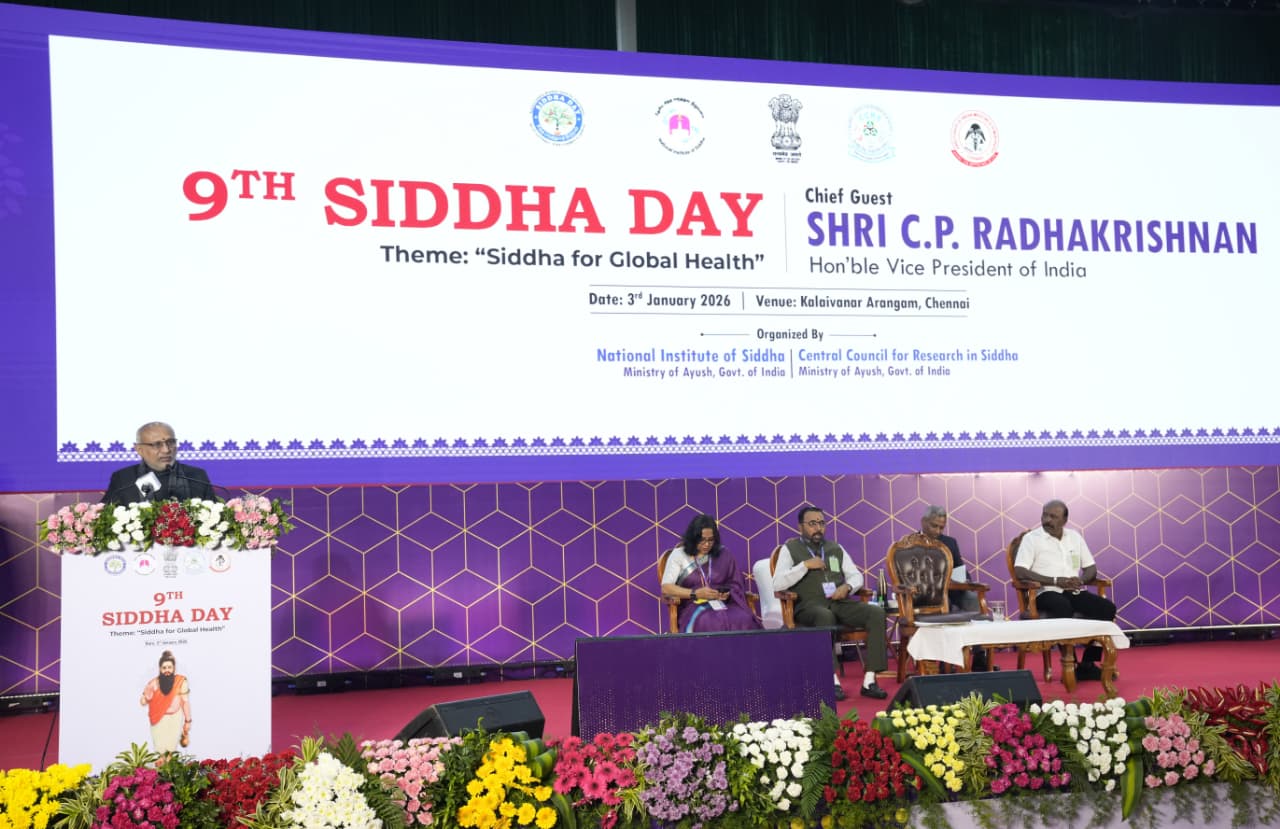
Vice President of India, CP Radhakrishnan, has called for global recognition of traditional medicine, highlighting the enduring relevance of Siddha medicine at the inauguration of the the 9th Siddha Day celebrations at Kalaivanar Arangam in Chennai.
Addressing a distinguished gathering of policymakers, practitioners, academicians, and students, he praised Siddha’s “strong philosophical foundations, scientific depth, and its holistic integration of body, mind and nature.”
He noted the enduring relevance of Siddha medicine as “a comprehensive, preventive and sustainable healthcare system in the contemporary world.”
Radhakrishnan emphasized that India’s traditional systems of medicine—including Siddha, Ayurveda, Yoga, and other AYUSH disciplines—are “not relics of the past but living traditions that continue to contribute significantly to the health and well-being of millions in India and across the globe.”
He described Siddha medicine as “among the country’s most ancient and profound medical traditions, rooted in knowledge accumulated over thousands of years,” noting its holistic approach that fosters harmony between body, mind, and the natural environment.
The Vice President also appreciated the exhibition of ancient palm-leaf manuscripts, classical texts, and medicinal herbs, lauding “the extraordinary efforts of scholars and institutions in preserving and rediscovering India’s traditional medical heritage.”
He warned that “due to historical neglect and inadequate documentation, many invaluable texts were at risk of dilution or loss,” stressing the urgent need for “sustained efforts in systematic collection, conservation and research to safeguard this knowledge for future generations.”
Highlighting Siddha medicine’s preventive approach, Radhakrishnan noted its growing relevance in today’s fast-paced lifestyles. “While acknowledging the advances made by modern medicine in diagnostics, traditional systems such as Siddha play a crucial role in long-term healing and restoring balance,” he said, urging practitioners to “strengthen public confidence through responsible and evidence-based practice.”
Encouraging young scholars, he expressed confidence that sustained research in Siddha medicine “could lead to major scientific breakthroughs, including permanent cures for presently incurable diseases,” and called for full financial support to ensure uninterrupted pursuit of advanced studies. He expressed hope that future generations of researchers would bring global recognition to India’s traditional medical knowledge systems.
The inaugural ceremony was attended by Prataprao Jadhav, Minister of State (Independent Charge), Ministry of Ayush and Minister of State, Ministry of Health and Family Welfare; MA Subramanian, Tamil Nadu Health Minister; senior officials from the Ministry of Ayush and the Tamil Nadu government; and heads of Siddha institutions.
Jadhav said Siddha medicine “embodies an advanced understanding of health, nature, and consciousness, making it highly relevant to modern holistic healthcare.”
He outlined major achievements in Siddha education and research, including infrastructure expansion at the National Institute of Siddha, skill-oriented and technology-enabled training programs, and strong research outputs from the Central Council for Research in Siddha. He noted that Siddha Morbidity Codes’ inclusion in WHO ICD-11 and the upcoming WHO international standard terminologies would “firmly place Siddha on the global healthcare map.”
Referring to international collaborations and WHO-led initiatives, Jadhav reaffirmed the government’s commitment to making Siddha “evidence-based, globally acknowledged, and accessible to all, while preserving its classical integrity.”
Five eminent personalities were felicitated for their outstanding contributions to Siddha medicine: Dr B Michael Jeyaraj, Dr T Kannan Rajaram, Late Dr I Sornamariammal, Dr Mohana Raj, and Dr V Banumathi. Their work in research, manuscript preservation, education, and leadership has significantly strengthened Siddha at grassroots, academic, and national levels.
The event, themed “Siddha for Global Health,” brought together practitioners, scientists, scholars, and students from across India.