At the CII Pharma & Lifesciences Summit 2026, industry and government leaders put regulatory reform, biopharma innovation and AI at centre of India’s pharma agenda
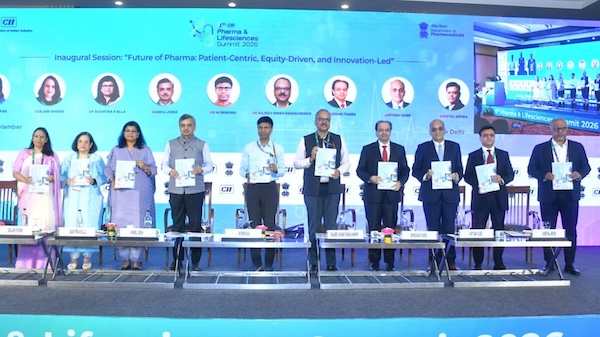
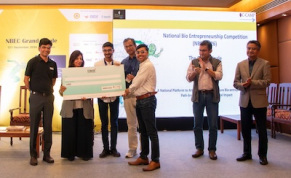
Industry leaders releasing the CII-EY-Parthenon India thought leadership report at the 8th CII Pharma & Lifesciences Summit 2026 on 18th September in New Delhi.
India’s pharmaceutical industry needs to move beyond its traditional manufacturing strengths and build capabilities in innovation, biopharma, advanced technologies and patient-centric healthcare, industry and government leaders said at the 8th CII Pharma & Lifesciences Summit 2026 in New Delhi.
Held under the theme “Future of Pharma: Patient-Centric, Equity-Driven, and Innovation-Led,” the summit brought together policymakers, regulators, pharmaceutical companies, investors and academia to discuss the next phase of India’s life sciences growth.
Dr Suchitra K Ella, President-Designate, CII (2026-27) and Co-Founder & Managing Director, Bharat Biotech International Limited, said India now has an opportunity to build on its manufacturing scale and scientific capabilities by investing in innovation, R&D, intellectual property and advanced technologies.
“We have built scale, manufacturing depth, scientific talent and a strong presence in the global healthcare scenario. The opportunity now is to look beyond and above — to build the next layer of that success, deepening into innovation, R&D, stronger intellectual property, advanced technologies and translational areas of discovery and products that can compete globally while remaining relevant to the patients and healthcare requirements of our own country, said Dr Ella.
Shreehas Tambe, Chairman, CII National Committee on Pharmaceuticals and CEO & Managing Director, Biocon, said India’s next phase of growth would require a stronger focus on biopharma, biotechnology and innovation.
“Our pharmaceutical exports have now exceeded $30 billion annually, and the next chapter must take India beyond our traditional strengths towards global leadership in biopharma, biotechnology, and innovation. As a country, we have the talent, entrepreneurial energy, and the manufacturing infrastructure. There is also growing recognition and a strong will to achieve what we have just outlined,” said Shreehas Tambe, Chairman, CII National Committee on Pharmaceuticals and CEO & Managing Director, Biocon.
Amitabh Dube, Co-Chairman, CII National Committee on Pharmaceuticals and Country President, Novartis Healthcare Private Limited expressed his high optimism about the future of India's pharmaceutical industry.
"India's pharmaceutical journey over the past few decades has been remarkable. We have become the pharmacy of the world, earning global trust through manufacturing excellence, scientific talent and affordable access to medicine. But the next decade will be different. Success will increasingly depend not only on our ability to manufacture medicines, but on our ability to discover, develop and deliver the next generation of medical breakthroughs," said Dube.
Dr. Rajeev Singh Raghuvanshi, Drugs Controller General (India), CDSCO, highlighted the shift towards digital regulatory processes.
“Digitisation is a tool for transparency, and trust is built only when there is transparency. Today, more than 99% of regulatory processes in India are now completely digital. We have almost moved away from paper-based processes, and that is a significant change, a change in processes and a change in mindset. You can see how this transformation has impacted the way regulatory processes are carried out,” said Dr. Raghuvanshi.
Manoj Joshi, Secretary, Department of Pharmaceuticals, called for regulation to become an advantage for the Indian pharmaceutical sector rather than a constraint.
“Instead of seeing regulation as a disappointment, we should turn it into an advantage. We often hear people cite China’s regulatory system as one of the reasons why the industry has moved so rapidly there. I hope that, in a year’s time, people will also start citing India as an example of how a faster, more responsive regulatory system can enable the sector to move forward. That is something we should strive for. I have been interacting with a lot of companies, and I am quite enthused by the risks these companies are willing to take and the confidence they are showing in pursuing innovation," said Joshi.
Prof. (Dr.) M. Srinivas, Member (Health), NITI Aayog, highlighted the need to strengthen capabilities across the biopharma value chain, from discovery and development to validation and manufacturing of next-generation biologics and biosimilars.
"There should be greater collaboration between government, academia, industry, start-ups and investors, as India seeks to evolve from the “pharmacy of the world” towards a “biopharma innovation partner to the world," said Srinivas.
Debjani Ghosh, Distinguished Fellow, NITI Aayog and Chief Architect, NITI Frontier Tech Hub, underlined India’s opportunity to play a larger role in shaping the next technological era.
“We have extra ordinary opportunities in front of us to help shape the next technological era. Not as a large market, but as an innovator, as a shaper of standards, as a shaper of the roles of the game. And as we do that, India is best placed, given our history to change the most important thing in the tech conversation," said Ghosh.
The summit’s first plenary focused on biosimilars, next-generation life sciences and the Biopharma SHAKTIinitiative. The agenda noted that the global biologics market is projected to exceed USD 900 billion by 2030, while biosimilars represent a USD 100 billion-plus opportunity. The government’s Biopharma SHAKTI scheme envisages Rs. 10,000 crore over five years.
The summit also featured the CII-EY-Parthenon India Thought Leadership Report, “Vision 2047: India — Building the Innovation Powerhouse of Tomorrow.”
The discussions also covered pharmaceutical supply chain resilience amid geopolitical, trade and climate-related disruptions. Industry and policymakers examined ways to reduce critical import dependencies while maintaining uninterrupted domestic medicine supplies and strengthening India’s global position.
Another session examined the growing role of AI and digital technologies across drug discovery, clinical trials, real-world evidence, regulatory compliance and connected manufacturing. The discussion also addressed technology adoption challenges for smaller and mid-sized pharmaceutical companies and the need for investment and regulatory alignment.
Rare disease financing and patient access formed another major theme. The summit agenda highlighted the financing gap faced by patients requiring disease-specific therapies and examined indigenous drug development, sustainable healthcare financing and access mechanisms.

Subscribe To Our Newsletter & Stay Updated