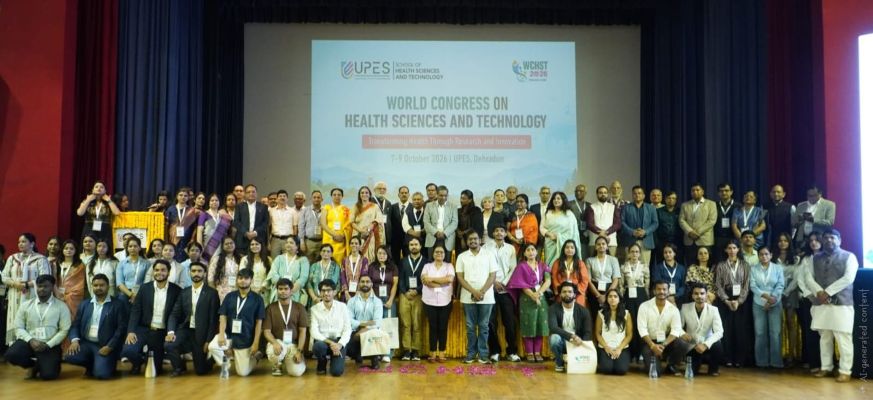
The convergence of traditional knowledge and modern science, the relevance of Ayurveda in contemporary healthcare, and the urgent need to shift from treatment to prevention took centre stage on the first day of WCHST 2026 in Dehradun.
Organised by the School of Health Sciences and Technology (SOHST), UPES, under the leadership of Padma Venkat, Dean, SOHST, UPES, and Nidhi Chauhan, Professor and Organising Secretary, SOHST, the three-day international Congress is being held from October 7 to 9 under the theme ‘Transforming Health through Research and Innovation’.
A dedicated session on ‘Ayurgenomics: Integrating Traditional Knowledge and Modern Genomics for Precision Healthcare’ examined how traditional medical knowledge and contemporary genomics could converge to advance precision healthcare.
The inaugural ceremony was led by Padma Shri Professor Balram Bhargava, former Director General of the Indian Council of Medical Research (ICMR) and former Secretary, Department of Health Research, Government of India, as Chief Guest. Sunil Rai, Vice Chancellor, UPES, was also present, while Dr. Soumya Swaminathan, former Deputy Director-General of the World Health Organisation, delivered the Presidential Address virtually.
Addressing the gathering, Professor Balram Bhargava, Former DG, ICMR said, “The World Congress on Health Sciences and Technology provides an important platform to strengthen research and innovation in healthcare. India has to invest more in newer drugs, biosimilars and innovative pharma, and I believe this institute and its students can contribute significantly to that. With such a brilliant campus and enabling environment, I am certain they will be able to do so.”
His remarks underscored the need to strengthen India's capabilities in drug development, biosimilars and pharmaceutical innovation, while highlighting the role academic institutions and emerging researchers can play in advancing healthcare.
Sunil Rai, Vice Chancellor, UPES said, “At UPES, we have been focusing on research and innovation in health sciences for early detection of terminal diseases, by harnessing science, technology, innovation, biomarkers, AI, and genomics, as well as the possibility of creating low-cost medical diagnostic instruments, making healthcare more accessible and affordable.
"We believe that a global platform like WCHST 2026 will allow us to achieve this goal by connecting scientific research with technology, clinical expertise, industry and policy. We hope it will enable meaningful international collaborations that move promising ideas beyond academic discussion and towards solutions that can create real impact for people and communities.”
The Congress places a strong emphasis on translating research into tangible healthcare outcomes, particularly in early disease detection, precision medicine and affordable diagnostics. Its scientific programme spans biotechnology, molecular biology, genomics, microbiology, pharmaceutical sciences, biomedical engineering, artificial intelligence in healthcare, digital health, public health, regenerative medicine and translational medicine.
Keynote lectures, panel discussions, research presentations, poster sessions and industry interactions will provide opportunities for experts to exchange ideas, develop research partnerships and explore solutions to emerging healthcare challenges.
International participation is a key feature of WCHST 2026, with experts representing institutions such as Purdue University in the United States, the Technical University of Munich in Germany and Florida International University in the United States.
The Congress also brings together researchers and specialists from King Abdullah University of Science and Technology, the All India Institute of Medical Sciences, IIT Roorkee, IIT Gandhinagar, CSIR–Central Food Technological Research Institute and CSIR–Institute of Genomics and Integrative Biology.
Industry participation from IBM India, Jubilant Biosys, CuraTeQ Biologics and Operon Technologies further strengthens the Congress's focus on connecting academia with healthcare delivery, emerging technologies and commercial innovation.
The inaugural day also featured a panel discussion titled ‘Nourish to Flourish (The Wellness Blueprint: Shaping a Healthier Future)’.
The session brought together experts from epidemiology, public health, food regulation, nutrition and media to examine the role of preventive healthcare and informed lifestyle choices in building healthier communities.
The panel included Jayanti Singh, Epidemiologist & Public Health Expert; GC Kandwal, Deputy Commissioner, FDA, Uttarakhand; Sukhwinder Singh, HOD, FSSAI, UT Administration, Chandigarh; Rajat Shakti, Station Head, Red FM 93.5; Roopa Soni, Nutritionist; and Ashu Jain, PhD, IIT-D, Hybrid Athlete and Health Influencer.
With its combination of scientific expertise, policy perspectives and industry engagement, WCHST 2026 seeks to strengthen cross-border partnerships and create new pathways for healthcare innovation. The Congress positions research, emerging technologies and collaborative problem-solving at the centre of efforts to make healthcare more accessible, affordable and effective.