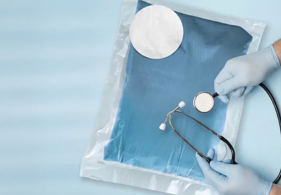
A groundbreaking international study supported by the NIHR has shown that Alzheimer’s disease biomarkers can be accurately detected using a simple finger-prick blood sample – a test that can be done at home and mailed to laboratories without refrigeration or prior processing.
The research, led by the US-based Banner Health Institute in collaboration with the University of Exeter Medical School, has been published in Nature Medicine. It marks the first large-scale validation of a testing approach that could be deployed anywhere in the world, without the need for specialised healthcare infrastructure.
The study, part of the DROP-AD project, was conducted across seven European medical centres, including Exeter, and involved 337 participants. Researchers confirmed that finger-prick blood samples can reliably measure key markers of Alzheimer’s pathology and brain damage.
Currently, Alzheimer’s diagnosis relies on brain scans or spinal fluid tests – procedures that are invasive, expensive, and difficult to access. Blood tests measuring biomarkers such as p-tau217 are emerging as accurate, accessible alternatives. While drawing blood from a vein is simpler than spinal taps or brain scans, practical hurdles like sample handling and access to trained staff have limited widespread use.
Professor Nicholas Ashton, senior director of Banner’s Fluid Biomarker Program and lead investigator, said: "This breakthrough could fundamentally change how we conduct Alzheimer's research by proving that the same biomarkers doctors use to detect Alzheimer's pathology can be measured from a simple finger prick collected at home or in more remote community settings.
“While we're still years away from clinical use, we're opening doors to research that was previously impossible – studying diverse populations, conducting large-scale screening studies, and including communities that have been historically underrepresented in Alzheimer's studies.
“Ultimately, we are moving toward a pathway of treating people for Alzheimer’s disease before symptoms emerge. If this trajectory continues, we will need innovative ways to identify eligible individuals who are not routinely presenting in clinical settings. This work represents one such approach in that direction and further validation remains.”
The findings could pave the way for global, at-home Alzheimer’s screening, potentially transforming early diagnosis and access to treatment.