A key focus of the Palm Conversations International India 2026 conference was the relationship between dietary fat consumption and cardiovascular health
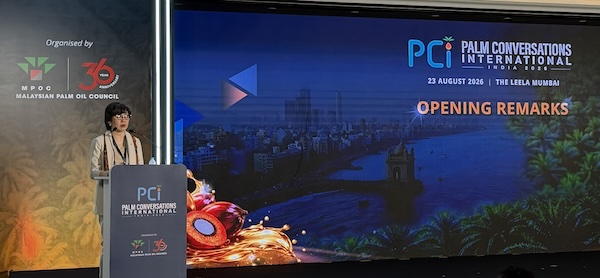
Khaw Wei Ping, General Manager, Scientific Affairs, MPOC, delivering her inaugural address at Palm Conversations International India 2026 in Hyderabad.
The Malaysian Palm Oil Council (MPOC) hosted the inaugural India edition of Palm Conversations International India 2026 (PCI), bringing together clinicians, researchers, nutrition experts and healthcare professionals to examine the potential health implications of Malaysian palm oil and its naturally occurring bioactive compounds in the context of rising non-communicable diseases (NCDs).
Held under the theme “Bioactive Power from the Palm: Reimagining Health for a World Facing Non-Communicable Diseases,” the conference focused on emerging scientific evidence around palm-derived compounds such as tocotrienols and palm phenolics, and their potential relevance to cardiovascular health, inflammation, metabolic health and cancer research.
The event brought together experts from cardiology, gastroenterology, biotechnology, oncology, integrative medicine and food science, including Dr. Ketan Mehta, Consultant Physician, Cardiopulmonologist & Diabetologist; Dr. Sudhir Mysore, Senior Consultant Gastroenterologist and Hepatologist, PACE Hospitals; Dr. A. Hannah Rachel Vasanthi, Professor, Department of Biotechnology, Pondicherry University; Dr. Sanjit Kanjilal, Chief Scientist, CSIR-Indian Institute of Chemical Technology; and Dr. Raghavendra Rao, Vice President – Research & Integrative Medicine, HCG Hospitals and former Director, CCRYN, Ministry of Ayush.
Belvinder Sron, CEO, MPOC, said the platform aims to facilitate evidence-based scientific dialogue between experts across disciplines and explore how advances in nutrition and health research could contribute to healthier lives.
A key focus of the conference was the relationship between dietary fat consumption and cardiovascular health. A review presented at the meeting, which screened 4,515 citations, found no consistent association between palm oil consumption and heart disease, stroke or cardiovascular mortality, although researchers acknowledged limitations in the available evidence.
The discussions also highlighted the importance of looking beyond individual food ingredients when assessing health outcomes. Dr. Vishal Malhotra, Senior Consultant – Healthcare at Makreo Research and Consulting, pointed to India's annual per-capita edible oil consumption of around 23.5 kg, compared with an ICMR-recommended level of approximately 12 kg, underscoring the importance of balanced dietary patterns in addressing NCD risk.
The conference also turned attention to palm-derived tocotrienols and phenolic compounds, which are being investigated for their potential biological effects. Dr. Roger Clemens, Adjunct Professor at the University of Southern California, discussed early research examining their possible roles in areas including cardiovascular health and inflammation.
In oncology, Dr. Raghavendra Rao discussed emerging research involving tocotrienols. Early human research has reported encouraging signals, including a 70% disease-stabilisation rate in a small Phase II study involving recurrent ovarian cancer, where delta-tocotrienol was administered alongside bevacizumab.
However, experts emphasised that larger clinical studies are required before such findings can translate into established therapeutic applications.
The healthcare-focused discussions stressed that palm-derived bioactives remain an emerging area of research and should not be considered substitutes for established NCD prevention or treatment.
Instead, experts called for greater emphasis on evidence-based nutrition, balanced diets, appropriate cooking practices and robust clinical research when evaluating the potential health benefits of food-derived bioactive compounds.

Subscribe To Our Newsletter & Stay Updated