India’s sickle cell disease programme has reached more than seven crore people through screening, identifying about 2.5 lakh patients and roughly 20 lakh carriers.
But at a national roundtable in the capital, doctors, scientists, public health experts and patient advocates said the next challenge is more difficult: ensuring that people who test positive do not disappear from the healthcare system.
The message from the meeting was clear: screening alone cannot eliminate sickle cell disease. India needs a continuous pathway from screening and diagnosis to treatment, monitoring and, where appropriate, transplantation.
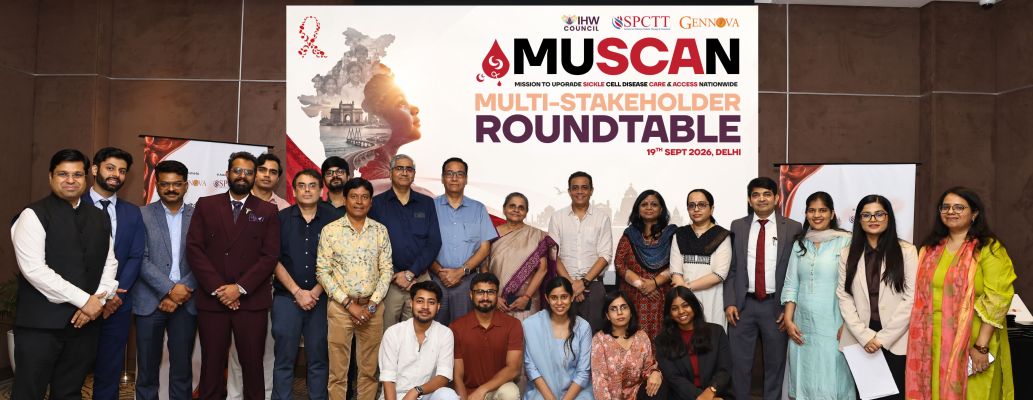
The roundtable was convened by Integrated Health & Wellbeing (IHW) Council in association with The Society for Pediatric Cellular Therapy and Transplant (SPCTT) under MUSCAN — Mission to Upgrade Sickle cell disease Care and Access Nationwide — an initiative of Gennova Biopharmaceuticals Ltd.
The initiative brought together representatives of government agencies, clinicians from public and private institutions, scientists, medical associations including SPCTT and the Pediatric Hematology Oncology Chapter of the Indian Academy of Pediatrics (IAP-PHO), as well as patient organisations including Network Alliance of Sickle Cell Organisations (NASCO) and Sickle Cell Foundation of Chhattisgarh.
The gap after screening
The central concern was what happens after a patient is identified.
Kammal Ssahu, President of the Sickle Cell Foundation, Chhattisgarh, a member of NASCO and a person living with sickle cell disease, described how patients can be lost between villages, health facilities and referral centres.
Samples may be collected in villages, he said, while results reach health facilities rather than families. Patients can then disappear from follow-up as they move between primary health centres, district hospitals and medical colleges. In some tribal districts, participants also highlighted shortages of hydroxyurea and the burden of travelling long distances for medication refills.
"A sample is collected in the village, but the result reaches the facility and not the family. Unless someone is made responsible for telling the family and bringing them back, we will keep losing patients between the screening camp and the clinic," said Kammal Ssahu.
Dr. Dipty Jain also cautioned against treating national screening figures as a complete picture of disease burden. Around half of reported cases come from a few states, she said, and differences in screening approaches may partly explain the concentration. Phase 1 data, she noted, should not be used alone to estimate the national burden. The next phase is expected to expand screening to antenatal and newborn populations.
Among the solutions discussed were unique patient identification linked to the ABHA health account, missed-call or SMS reminders for medicine refills, village-level medicine depots, tele-consultation and a greater role for ASHA workers.
Programme guidelines already envisage sickle cell disease services at primary and community health centres, rather than concentrating care only at district hospitals.
"Sickle cell work in India has so far proceeded in compartments: screening, prevention, care and transplant. This roundtable was about bringing those compartments together," said Dr Gaurav Kharya.
Treatment cannot wait for a crisis
Clinicians stressed that SCD care must begin well before complications become emergencies.
Hydroxyurea, they said, needs to be appropriately dosed and monitored for individual patients. Transfusions should be based on clear clinical indications, while vaccination and regular organ assessments need to form part of routine care.
Haematopoietic stem cell transplantation (HSCT) remains the only established curative treatment available in India. Centres including FMRI, Gurgaon and Apollo Hospitals, Delhi, presented encouraging results, particularly among patients with matched sibling donors and those receiving treosulfan-based conditioning regimens.
However, the results cited were from individual centres and had limited follow-up. Speakers said outcomes can be better when patients are referred at a younger age, before significant organ damage develops. Yet many patients reach transplant centres only after the age of 10.
SPCTT presented 14 evidence-based recommendations on when transplantation should be considered. The recommendations were developed over approximately a year by a national and international panel, with participation from ICMR and NASCO. The HSCT for SCD Guidelines from SPCTT are expected to be made available for reference soon.
"Our aim is to help families and doctors decide, on evidence, who should be considered for transplant and when. Referral before organ damage sets in changes outcomes." Dr SP Yadav
Gene therapy also featured in discussions, with experts pointing to its potential while stressing the need to address cost, manufacturing capacity, regulation and trained centres. Participants emphasised that future advanced therapies will depend on a functioning basic care system capable of identifying, monitoring and supporting patients.
Funding emerges as a critical gap
Participants said the 2047 elimination goal cannot be pursued through screening budgets alone.
Long-term care requires reliable financing for medicines, vaccines and safe blood, as well as village-level medicine supplies, digital patient tracking and training for frontline doctors.
Support for transplantation and prenatal testing is available through government schemes, but awareness and navigation remain challenges for families. Figures cited at the meeting included prenatal testing support of up to ₹15,000 under Ayushman Bharat PM-JAY and transplant support of up to ₹15 lakh under the Rashtriya Arogya Nidhi scheme, subject to BPL documentation, alongside various state-level schemes.
Participants proposed a verified guide covering central and state schemes as well as CSR support, supported by help desks that can assist families with documentation and applications.
They also called for stronger public-sector capacity backed by financing, arguing that access to curative treatment should not deepen existing inequalities in healthcare.
From roadmap to implementation
The meeting identified several next steps, including publication of the HSCT for SCD SPCTT Guidelines, development of an online SCD certification course for paediatricians and physicians modelled on an existing thalassaemia programme, and further regional meetings involving clinicians and patient groups.
Dates for these initiatives have not yet been announced.
Introducing MUSCAN, Dr Raonak Karnde, Cluster Medical Lead at Gennova Biopharmaceuticals Ltd, who also moderated the panel discussion, described the initiative as a platform intended to bring different parts of the sickle cell ecosystem together.
"MUSCAN is meant to be one table where government, clinicians, scientists and patients work on the same problem. This is the first of a series, and the aim is practical, action-oriented solutions for patients and health systems," said Dr Raonak Karnde.
The National Sickle Cell Anaemia Elimination Mission was launched by Prime Minister Narendra Modi in Shahdol, Madhya Pradesh, on July 1, 2023, with the stated goal of eliminating SCD as a public health problem by 2047.
The roundtable's central question now moves beyond how many people India can screen to how many identified patients can be kept consistently connected to care.





.png)