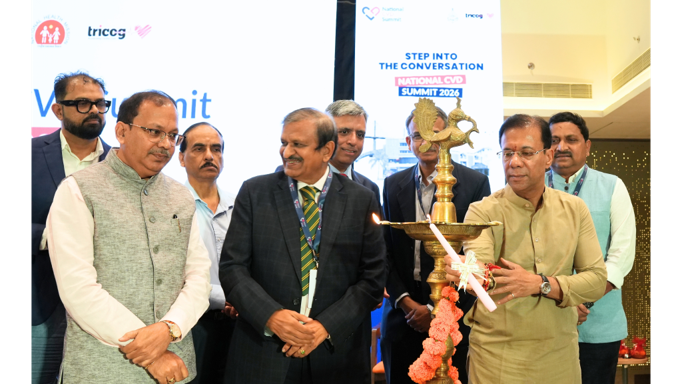
India needs to close the gap between cardiovascular health policy and what actually reaches patients on the ground, healthcare leaders and policymakers said at the conclusion of the three-day National CVD Summit 2026 in Goa.
Organised by the Government of Goa in association with Tricog Health, the summit brought together policymakers, clinicians, public health leaders, researchers and implementation experts from across the country to examine how cardiovascular care can be scaled beyond individual centres of excellence.
Held under the theme “Policy and Implementation for Scalable Cardiovascular Care,” the summit focused on the entire cardiac-care continuum — from prevention and screening to emergency response, referral, reperfusion, treatment and long-term management.
The discussions drew on experiences from Goa, Uttar Pradesh, Karnataka, Odisha, Maharashtra, Manipur, Mizoram, Meghalaya, Nagaland, Assam, Bihar, Jharkhand, Kerala, Tamil Nadu, Punjab and New Delhi.
Vishwajit Rane, Minister for Health, Government of Goa, said the state’s experience was rooted in confronting the access gaps that patients faced decades ago.
"Thirty-five years ago, when my father had a heart attack, there was no ambulance and no cardiac expertise nearby, only a drive to Goa Medical College and a phone call to doctors in Bombay and the United States for guidance. That is the gap this programme was built to close. In Goa, no patient is turned away, and no protocol is compromised, and patients get everything free of cost from Treatment to Medication."
Yatindra M. Maralkar, Health Secretary, Government of Goa, highlighted the state’s referral network, saying, “Every district hospital in Goa is now connected to a STEMI referral pathway, backed by Tricog's AI-enabled ECG diagnostics at the point of care."
Charit Bhograj, Founder & CEO, Tricog Health, said the central challenge was ensuring that timely cardiac care is not determined by where a patient lives.
"Every heartbeat deserves the same thing my own family would get with one phone call: the right treatment, in time. Most of India doesn't have that privilege yet. That's the gap we built Tricog to close.”
A major focus of the summit was India’s response to ST-elevation myocardial infarction (STEMI), where delays in diagnosis and reperfusion can affect outcomes.
State experiences from Goa, Uttar Pradesh, Karnataka, Odisha, Maharashtra, Tamil Nadu and Punjab gave delegates an opportunity to examine different approaches to hub-and-spoke networks, first-contact diagnosis, patient transport, referral systems, spoke capabilities and data infrastructure.
CN Manjunath, Member of Parliament and former Director of the Sri Jayadeva Institute of Cardiovascular Sciences & Research, delivered the keynote address on “Cardiovascular Care in India.”
“Sixty per cent of India lives without access to a cath lab, and every thirty minutes of delay raises the risk of death by seven per cent. We already have what we need: tenecteplase, AI-assisted diagnosis, and a hub-and-spoke model proven in both Karnataka and Goa. What's missing is the policy to match it, at scale, everywhere. Heart attack cannot wait."
Goa’s statewide STEMI programme, which began in 2018, was presented alongside experiences from other states.
Guruprasad Naik, HOD of Cardiology, Government Medical College, Goa, said: "The state of Goa has led the design and implementation of a statewide STEMI program, starting in 2018. Building on this, we are excited that the state of Goa is hosting the National CVD Summit. We are hoping that this will further stimulate an understanding of the impact of the various forms of CVD on the Indian population, leading to improvements in care and outcomes for the entire Indian population."
Discussions on reperfusion examined fibrinolysis, primary PCI and pharmaco-invasive approaches, while also addressing the practical realities of geography, infrastructure, affordability, access and time.
The summit also stressed that India’s cardiovascular response cannot begin only after a major cardiac event.
Participants examined the need for earlier risk identification, screening, clearer referral pathways and stronger links between community-level programmes and specialist care.
Other sessions focused on paediatric and women’s cardiovascular health, heart failure, data systems, financing, health technology assessment and the responsible use of AI and other emerging technologies.
A dedicated technology session examined AI-enabled diagnostics, national-scale clinical operations and regulatory considerations around medical-device deployment in cardiovascular programmes.
Heart failure was another major focus, with discussions covering registry evidence, earlier identification of left ventricular systolic dysfunction, statewide care pathways, gender-related differences in outcomes and stronger surveillance.
The emphasis was on linking early detection with decentralised management, specialist referral and long-term follow-up rather than treating diagnosis as the end point of care.
The summit concluded with a closed-door document-preparation session aimed at consolidating key learnings and chair-led suggestions into recommendations for the Ministry of Health and Family Welfare.
The recommendations focus on scaling cardiovascular care across prevention and screening, STEMI systems, reperfusion access, paediatric and women’s heart health, heart failure, data infrastructure and responsible technology use.
The central message from the three-day summit was that India already has clinical expertise, state-level programmes and increasingly capable digital tools. The challenge is connecting these strengths through common pathways, reliable referral systems, measurable programme design and sustained collaboration between government, clinicians, public health institutions and technology partners.



.png)