Medical colleges rise from 387 to over 800, undergraduate medical seats nearly triple in 12 years
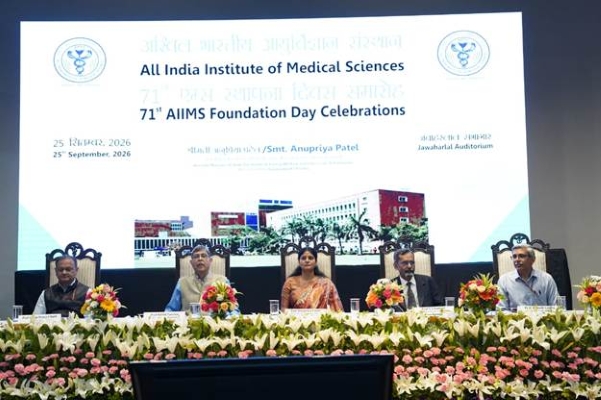
Union Minister of State for Health & Family Welfare and Chemicals & Fertilizers, Anupriya Patel, has called on AIIMS New Delhi to deepen its role as a national centre of advanced clinical care, medical education, research and innovation, while ensuring that technology strengthens rather than replaces the human side of healthcare.
Addressing the 71st Foundation Day celebrations of the All India Institute of Medical Sciences (AIIMS), New Delhi, as Chief Guest last week, Patel said the institution’s seven-decade legacy carries an even greater responsibility as India expands its healthcare infrastructure and medical workforce.
She said that “since its inception in 1956, AIIMS New Delhi has occupied a special place in the healthcare journey of the country.” Over the decades, she added, “the name AIIMS has become synonymous with clinical excellence and public trust.”
The Minister highlighted the dramatic expansion of India’s medical education ecosystem, noting that the country has grown from a single AIIMS at the turn of the century to a network of 23 institutions.
Since 2014, the number of medical colleges has increased from 387 to more than 800, while undergraduate medical seats have risen from 51,000 to nearly 1.3 lakh. The government, she said, plans to add another 75,000 medical seats.
But Patel stressed that the expansion cannot be measured in numbers alone.
“Quality medical education must reach every region, advanced tertiary healthcare must be brought closer to citizens, and the country must build a strong pool of doctors, nurses, scientists and allied healthcare professionals capable of responding to changing demographic and epidemiological needs.”
She added that “AIIMS New Delhi has a special responsibility in this transformation as the apex mentor and as an institution that has established a benchmark for the rest of the country.”
Technology must serve patients, not replace doctors
Patel placed technology at the centre of the future of healthcare, while drawing a clear line on its role.
AIIMS is already operating at the forefront of artificial intelligence, robotic surgery, organ transplantation and advanced diagnostics, she noted. But “technology must remain an instrument for better patient care and should complement, rather than replace, human clinical judgement.”
“AI cannot replace a physician’s intuition, a robotic arm cannot replace a surgeon’s judgement, and technology cannot replace the reassuring human presence of a nurse,” she said.
The Minister also stressed that technological progress must be matched by improvements in the patient experience. She called for AIIMS campuses to become easier for citizens to navigate and emphasised empathy, clear communication, dignity, patient safety and patient-centred care.
She said healthcare expansion must also keep pace with quality. A new ward, she noted, requires adequate nursing support; specialised services require trained professionals; and digital initiatives should reduce, rather than add to, the difficulties faced by patients.
From treating disease to preventing it
Patel also called for greater emphasis on prevention, early detection and timely treatment, particularly as India faces a growing burden of non-communicable and lifestyle-related diseases.
She urged AIIMS to use its intellectual capital to contribute to public health policy, community health, lifestyle management and preventive medicine, while advancing the broader preventive and promotive healthcare approach reflected in the National Health Policy, 2017.
She also highlighted the role of Ayushman Bharat and Pradhan Mantri Jan Arogya Yojana (AB PM-JAY) in expanding healthcare access and protecting vulnerable families from financial hardship. AB PM-JAY, she noted, has completed eight years and covered more than 62 crore beneficiaries.
AIIMS urged to become a national innovation hub
Patel called on AIIMS New Delhi to expand its role beyond treating patients on its own campus and become a national hub for capacity building, research and indigenous medical innovation.
She said the institution’s impact should also be measured by the healthcare professionals it trains and the expertise it helps take to other parts of the country.
Research, she stressed, must bridge the gap between laboratories and patients and translate into clinical applications and public benefit.
The Minister also called for greater development, validation and adoption of indigenous medical technologies, saying India cannot depend indefinitely on imported solutions.
She called upon AIIMS “to contribute to an ecosystem in which India not only adopts advanced healthcare solutions but also develops them.”
Healthcare workers need care too
Patel also turned attention to the well-being of healthcare professionals, stressing that the health of doctors, nurses and other healthcare workers is central to building a healthy nation.
She called for healthy habits to be encouraged among healthcare professionals from a young age and for institutions to foster a culture that supports their physical and overall well-being.
Looking ahead, she urged AIIMS New Delhi “to play an even more commanding role in advanced clinical care, nurture the next generation of compassionate healthcare professionals, undertake research addressing India’s unique health challenges and guide the broader AIIMS network as a unified family of institutions.”
Patel also acknowledged the contribution of the entire AIIMS workforce, including doctors, nurses, researchers, students, technicians, pharmacists, administrators, sanitation workers and security personnel.
She said AIIMS must continue making patient care more accessible, safer and increasingly patient-centred, while ensuring that technology strengthens—not replaces—the human relationship at the heart of healing.
AIIMS records over 50 lakh outpatient visits
Director, AIIMS New Delhi, Dr. (Prof.) Nikhil Tandon, highlighted the enormous scale of the institution’s operations.
During the past year, AIIMS New Delhi recorded more than 50 lakh outpatient visits, admitted over 3.5 lakh patients and conducted nearly 3 lakh surgeries.
Tandon said the numbers reflected the immense trust placed in the institution by patients from across the country.
He also highlighted advances in clinical care, including more than 1,000 robotic surgeries and the successful performance of India’s first reported robot-assisted kidney transplant in a public sector institution.
AIIMS also doubled its dialysis capacity and carried out more than 300 highly complex super-microsurgical procedures, he said.
The institution is simultaneously expanding its national role in capacity building, digital health, research and indigenous innovation. Around 1,000 new students joined AIIMS during the year, while more than 300 faculty members were recruited.
Tandon emphasised that AIIMS must take its expertise beyond its campus through digital health, telemedicine and capacity-building initiatives to strengthen healthcare delivery nationwide.
Seven decades of healthcare innovation on display
As part of the Foundation Day celebrations, Patel inaugurated the exhibition “AIIMS: Seven Decades of Healthcare Innovation”, showcasing the institution’s journey through 95 posters covering major milestones, achievements, initiatives and developments.
The exhibition also has a strong focus on health education and community outreach.
In her concluding remarks, Patel said AIIMS New Delhi has a distinguished past and a strong present, but carries an even greater responsibility to shape the future of Indian healthcare. She called on the institution to remain a beacon of excellence, trust, affordability, innovation and selfless service to the people of India.

Subscribe To Our Newsletter & Stay Updated