In a major step towards strengthening healthcare in India's high-altitude regions, the Indian Council of Medical Research (ICMR) has established the Centre for High Altitude Medicine and Public Health Research at Keylong, Himachal Pradesh.
The aim is to address the unique health challenges faced by Armed Forces personnel and civilians living in the Himalayan belt.
The centre will focus on research into the health effects of low oxygen levels, extreme cold and changing climatic conditions, while developing evidence-based strategies to improve disease prevention, diagnosis and healthcare delivery in some of India's most challenging terrains.
Former Lahaul and Spiti MLA Ravi Thakur expressed confidence that research conducted at Keylong would lead to improved healthcare and preventive measures for communities across neighbouring Himalayan regions.
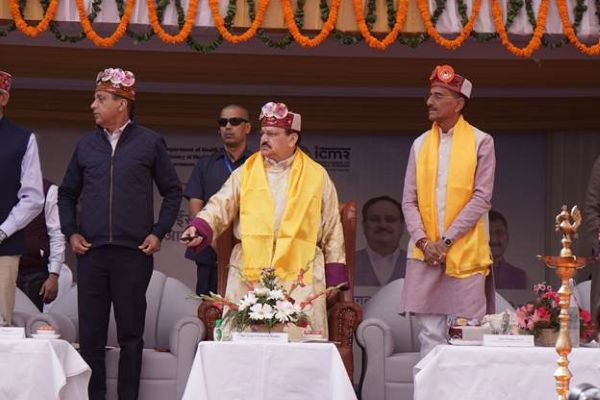
Union Health Minister Jagat Prakash Nadda marked the occasion by planting native Himalayan saplings under the Green ICMR Campus Initiative. He also inaugurated a scientific exhibition for school students, launched the centre's website and institutional video, and released a commemorative postal special cover marking key milestones in the institution's establishment.
Senior officers of the Armed Forces Medical Services and the Indian Air Force, scientists, Panchayati Raj representatives and local residents attended the ceremony.
Built on the foundation of an ICMR field station established at Keylong nearly a decade ago, the new centre will function as a permanent, year-round research institution equipped with state-of-the-art laboratories and specialised scientific personnel.
Its core mandate is to generate scientific evidence on how high altitude, oxygen deprivation, extreme cold and climate change affect human health. The research will cover altitude-related illnesses, acclimatisation, maternal and newborn health, child growth and nutrition, and disease patterns among Himalayan communities.
A key pillar of the initiative will be collaboration between ICMR, the Armed Forces Medical Services and other research institutions. The partnership is expected to combine expertise in biomedical research, public health and high-altitude physiology, with findings relevant to both military personnel deployed in difficult terrain and civilians living in remote mountain communities.
The centre will also examine how emerging technologies, including drone-enabled medicine delivery, digital health solutions and artificial intelligence, can help overcome healthcare access barriers in remote and difficult-to-reach areas.
These technologies could support the delivery of essential medicines and improve healthcare access in communities where difficult terrain, harsh weather and long distances often pose major challenges.
The research findings are expected to inform clinical practices, strengthen preventive healthcare and improve medical support for Armed Forces personnel stationed at high altitudes.
The centre will also seek to support better healthcare services across India's Himalayan and border regions, including Himachal Pradesh, Ladakh, Jammu and Kashmir, Uttarakhand, Sikkim and Arunachal Pradesh.
With its focus on high-altitude medicine, public health and technology-driven healthcare solutions, the Keylong centre is set to serve as a dedicated research hub for addressing the distinct medical challenges of life and service in the Himalayas.