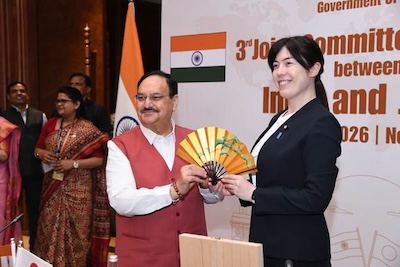
The 3rd Joint Committee Meeting (JCM) on Healthcare between India and Japan was held at Bharat Mandapam, reaffirming the two countries’ commitment to strengthening bilateral healthcare cooperation.
The meeting was co-chaired by Jagat Prakash Nadda, Union Minister of Health and Family Welfare, and Kimi Onoda, Minister in charge of Healthcare Policy, Japan.
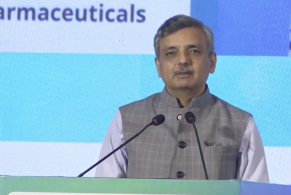
Welcoming the Japanese delegation, Punya Salila Srivastava, Union Health Secretary, said the India-Japan partnership is rooted in mutual trust and shared vision, with the Joint Committee Meeting serving as a key platform for advancing healthcare collaboration through dialogue and cooperation.
Addressing the meeting, Nadda said the engagement reflects the shared commitment of both nations to deepen healthcare partnerships and promote innovation, accessibility, and stronger health systems under the India-Japan Memorandum of Cooperation in Healthcare and Wellness.
Onoda highlighted Japan’s commitment to advancing healthcare collaboration through innovation, technology, and research partnerships.
Key discussions during the meeting covered prevention and management of non-communicable diseases (NCDs), resilient healthcare supply chains, digital health, and healthcare workforce development.
India highlighted its expanding pharmaceutical and medical devices manufacturing ecosystem, along with the progress of the Ayushman Bharat Digital Mission in creating a secure and interoperable digital health infrastructure.
Japan shared its expertise in AI-enabled healthcare technologies, cancer screening programmes, system integration, and public-private collaboration models for strengthening healthcare delivery and supply chains.
Both countries also discussed joint training programmes, scientific exchanges, and collaborative research initiatives aimed at developing a globally competitive healthcare workforce.
Concluding the meeting, Shri Nadda said the discussions have given renewed momentum to the India-Japan health partnership and laid a strong foundation for resilient and inclusive healthcare systems. Both sides expressed optimism about further strengthening bilateral cooperation for improved health outcomes.