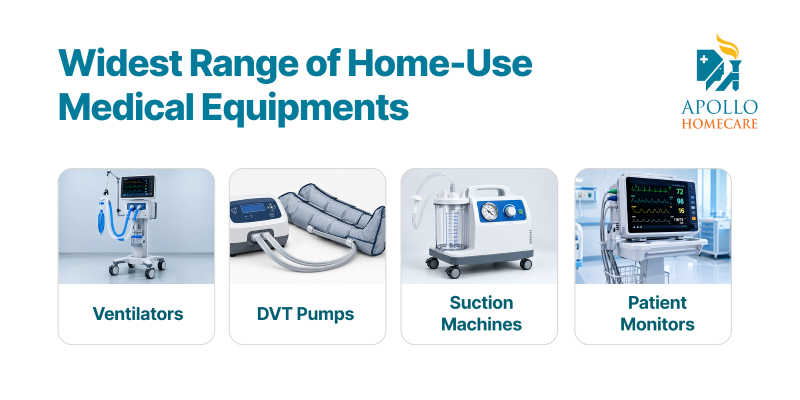
Apollo Homecare’s medical equipment business has hit a new growth gear, with rentals nearly doubling year-on-year and sales surging nearly 140% in FY26.
The sharp acceleration marks a significant shift from the previous year, when rental growth stood at around 7% and sales grew by approximately 24%.
Behind the numbers is a changing approach to healthcare in India. More families are turning to home-based medical equipment to manage recovery after hospitalisation, support patients with chronic conditions and facilitate care following discharge from intensive care units (ICUs).
Oxygen concentrators, CPAP machines, hospital beds and wheelchairs—once largely associated with hospitals—are increasingly finding their way into Indian homes. Respiratory equipment accounts for a substantial share of demand at Apollo Homecare, reflecting the growing need for specialised care as clinically stable patients transition from hospital ICUs to their homes.
The shift is playing out against a rapidly expanding market. According to IMARC Group, India's homecare medical equipment market was valued at approximately US$ 1.5 billion in 2025 and is projected to reach US$ 2.4 billion by 2034. Apollo Homecare’s FY26 performance underscores the momentum building behind this transition.
As demand rises, Apollo Homecare has expanded its sales and service network across six major cities—Delhi NCR, Chennai, Bengaluru, Hyderabad, Mumbai and Kolkata—while offering pan-India delivery beyond these hubs.
The company has also upgraded its e-commerce platform to simplify the process of selecting and procuring medical equipment. Families can compare renting with buying, explore financing options and access guidance from trained technicians and biomedical engineers through a single platform.
The push addresses a problem many families face at a critical moment: arranging the right equipment quickly, often without prior knowledge of the products available, their costs or the support required to use them safely.
Vishal Lathwal, CEO, Apollo Homecare, said, "Most families end up in a peculiar situation at the time of hospital discharge or post a Doctor consultation. The tedious journey of navigating between products, providers and pricing. The decision is rushed given need and the options feel overwhelming. We want to change that.
"We partner with our patients and help make an informed choice starting with expert-backed counselling to choose the right product, flexibility of buying vs renting and which makes the most sense for them, financing the purchase if needed, doorstep installation and post purchase support."
The economics of home-based medical equipment are adding to its appeal. For families managing short-term recovery, renting equipment can be considerably cheaper than extending a hospital stay. For patients requiring long-term support, purchasing equipment may prove more economical over time.
Hospitals, meanwhile, stand to benefit when clinically stable patients can transition home with appropriate equipment and care arrangements. The move can help free up acute-care beds for patients who need hospital-level treatment, while enabling others to continue their recovery in a familiar environment.
But the benefits depend on more than equipment availability. Patients and caregivers need access to the right products, appropriate guidance, installation and after-sales support to make home-based care viable.
Despite the market’s growth, awareness has not kept pace with access. Many families discover that hospital-grade medical equipment can be rented for home use only when a patient is ready for discharge—leaving them to navigate unfamiliar products, providers and pricing under pressure.
The expanding market has brought more options, but choice alone does not guarantee informed decisions. For families encountering home medical equipment for the first time, knowing what to rent, what to buy and where to turn for reliable support can be as important as the equipment itself.
Apollo Homecare is seeking to address this gap through its product portfolio, digital platform, service network and emphasis on helping customers make informed choices rather than simply complete transactions.
The FY26 numbers point to a clear acceleration in demand. The next phase of growth, however, may depend on how quickly awareness catches up with availability—and whether more Indian families come to see home-based medical equipment as a practical, accessible part of the healthcare journey.