Experts discussed strategies to strengthen international collaborations, streamline the transition of scientific discoveries into first-in-human clinical trials, and improve coordination among innovators, investors and translational platforms
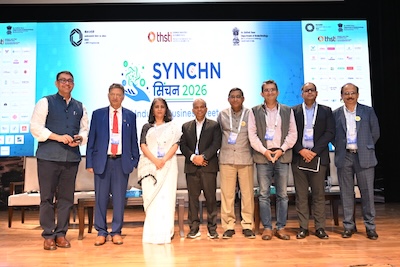
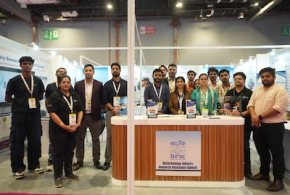
The Translational Health Science and Technology Institute (THSTI), an institute of the Biotechnology Research and Innovation Council (BRIC) under the Department of Biotechnology (DBT), Government of India, hosted the third edition of its annual industry-business meet, SYNCHN 2026 (Synergistic Collaboration in Healthcare Innovation).
The event brought together leading scientists, policymakers, industry executives, investors and startups to strengthen India's translational healthcare ecosystem.
Held at the NCR Biotech Science Cluster campus in Faridabad, the event focused on bridging the gap between laboratory research and commercial healthcare products by fostering collaborations across academia, industry and government.
Delivering the keynote address virtually, Dr Kiran Mazumdar-Shaw, Executive Chairperson, Biocon said, “I believe the 21st century will increasingly belong to Biology and Biotechnology, led by AI. While India has built world-class scientific institutions, our challenge has never been science but its translation.”
“Building an ecosystem that takes innovation seamlessly from discovery to commercialization is precisely why advanced institutes like THSTI and platforms like SYNCHN are so critical. Value is created only when scientific excellence matches translational excellence through cross-boundary trust and collaboration," she added.
Welcoming delegates, Prof. Ganesan Karthikeyan, Executive Director, THSTI, highlighted the growing impact of the SYNCHN platform. He noted that the inaugural edition in 2024 resulted in 13 Letters of Intent, while SYNCHN 2025 led to 19 strategic partnership agreements, reflecting stronger industry engagement.
Prof. Karthikeyan reaffirmed THSTI's focus on measurable translational outcomes, showcasing the institute's expanding infrastructure, including its fully operational Medical Research Centre (MRC) and the Accelerated Productisation and Epidemic Preparedness (APEX) initiative.
The Medical Research Centre houses an early-phase clinical trial unit, an advanced CAR-T cell research facility, and India's first Controlled Human Infection Studies (CHIS) facility, while APEX serves as a national-scale pilot manufacturing platform designed to bridge the "valley of death" between promising laboratory discoveries and commercially manufacturable biologics.
The conference also featured key policy updates from senior government officials. Dr Rajeev Singh Raghuvanshi, Drugs Controller General of India (DCGI), said the Central Drugs Standard Control Organisation (CDSCO) is working towards a new regulatory framework for biologics that will incorporate industry experts to modernise regulatory processes.
Meanwhile, Prof. M. Srinivas, Member, NITI Aayog, emphasised the importance of converting scientific discoveries into affordable, scalable healthcare solutions through stronger collaboration between research institutions and leading clinical centres.
Speaking on the financing landscape, Dr Manish Diwan highlighted the newly operational BIRAC Research Development and Innovation (RDI) Fund as an important mechanism to bridge funding gaps across the innovation lifecycle for startups, industry and research institutions. Amit Pandey of the Indian Venture and Alternate Capital Association (IVCA) noted that India's bioeconomy continues to grow at an impressive 18% annually, creating significant opportunities for biotech innovation.
The summit featured several high-level panel discussions covering global health partnerships, clinical translation and commercialisation.
Experts discussed strategies to strengthen international collaborations, streamline the transition of scientific discoveries into first-in-human clinical trials, and improve coordination among innovators, investors and translational platforms to accelerate biotech product development.

Subscribe To Our Newsletter & Stay Updated