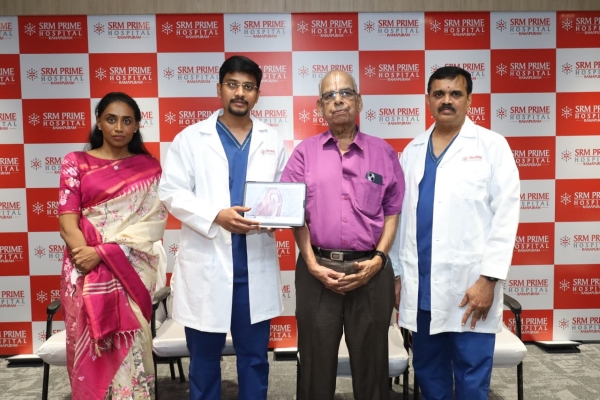
In a groundbreaking medical feat, SRM Prime Hospital has pulled off what doctors are calling an India-first—saving a 73-year-old patient’s life with a rare, alternative-access heart valve replacement after conventional methods proved impossible.
The patient, suffering from calcific severe aortic stenosis—a dangerous narrowing of the heart valve caused by calcium buildup—had run out of standard treatment options. Blocked and unsuitable blood vessels ruled out the usual route through the leg artery, forcing doctors to innovate under pressure.
Instead, the surgical team took an unconventional path—threading a life-saving valve through the artery beneath the patient’s right shoulder, known as the right axillary artery. The result: a successful Transcatheter Aortic Valve Replacement (TAVR), performed without open-heart surgery.
The outcome was swift and striking. The patient, a retired professional, was discharged just three days later and has already returned to normal daily life.
The high-stakes procedure was led by Dr Balamurugan S alongside a multidisciplinary team of specialists.
“The patient exhibited features of decompensated heart failure, where the heart is unable to pump effectively. Our evaluation confirmed calcific severe aortic stenosis, a narrowing of the aortic valve caused by calcium deposits that restrict blood flow.
"Given his age and condition, we opted for TAVR/TAVI; however, none of the standard access routes such as femoral, transcarotid, transcaval or Left subclavian, were feasible. The only viable option was the right axillary artery. We therefore performed this entirely percutaneous right trans-axillary TAVR, an India-first, using an advanced catheter-based valve delivery system.”
He further added, “Modern treatments like TAVR provide safe and minimally invasive options, as there is less surgical trauma and faster recovery options, especially for elderly patients or those at high risk for open-heart surgery.
"In this case, it required advanced pre-procedure planning and precise catheter manipulation due to the tortuous course of the artery, along with expertise in alternative vascular access techniques. We are happy that our team, with utmost dedication to the quality outcome, performed the first of the kind procedure in India, and saved the senior citizen’s life.”
Dr A Thomas George highlighted the complexity of treating elderly patients with multiple conditions: “Patients undergoing advanced procedures like TAVR are often elderly and have multiple underlying health conditions that need careful medical management. Our focus is on optimising these conditions and ensuring the patient remains stable throughout the treatment journey.”
Aortic stenosis, which affects an estimated 2–7% of people over 65, remains a serious and often underdiagnosed condition. Doctors warn that symptoms such as fatigue, breathlessness, chest pain, and fainting should not be ignored, as early detection can be life-saving.
This landmark procedure not only underscores the growing capabilities of minimally invasive cardiac care in India but also opens new possibilities for high-risk patients previously considered untreatable.