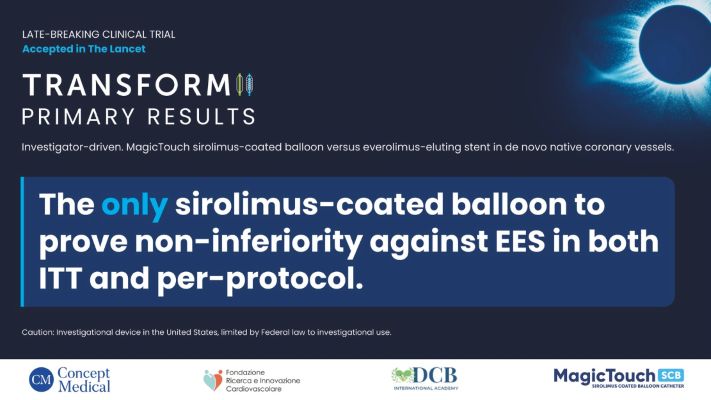
A major international clinical trial has delivered a significant boost to the case for stent-free coronary intervention, finding that sirolimus-coated balloon (SCB) angioplasty is non-inferior to contemporary everolimus-eluting stents (EES) in treating de novo coronary artery disease.
The findings from the TRANSFORM II randomised trial demonstrate that the MagicTouch Sirolimus-Coated Balloon (Concept Medical) can deliver clinical outcomes comparable to a contemporary drug-eluting stent at 12 months—without routinely leaving a permanent metal implant inside the coronary artery.
The results could mark an important shift in percutaneous coronary intervention (PCI), challenging the long-standing reliance on permanent metallic stents as the default treatment strategy for coronary artery disease.
TRANSFORM II was an investigator-initiated, open-label, non-inferiority trial involving 1,842 patients treated at 53 centres across 11 countries in Europe, Asia and South America.
Patients with de novo native coronary artery lesions, measuring 2.0 to 3.5 mm in vessel diameter and up to 50 mm in lesion length, were randomly assigned to receive either the MagicTouch SCB, with bailout stenting if required, or an everolimus-eluting stent.
Crucially, randomisation took place only after successful lesion preparation, in line with recommendations from the Drug-Coated Balloon Academic Research Consortium. This approach was designed to reflect the importance of adequate lesion preparation in drug-coated balloon treatment.
The trial population represented a challenging real-world clinical profile. Nearly half the patients had acute coronary syndrome, more than one-third had diabetes, and approximately one-third were at high risk of bleeding.
At 12 months, target lesion failure (TLF), the trial's primary endpoint, occurred in just 2.1% of patients treated with SCB, compared with 2.4% in the EES group.
The hazard ratio was 0.86. The risk difference of −0.40 percentage points, with a one-sided upper confidence bound of 0.78 percentage points, remained comfortably below the prespecified non-inferiority margin of 1.5 percentage points.
TLF was defined as a composite of cardiac death, target-vessel myocardial infarction and ischaemia-driven target lesion revascularisation.
The findings remained consistent across per-protocol and device-received analyses, as well as across prespecified patient subgroups.
One of the key findings was the low rate of bailout stenting in the SCB group. Just 7.6% of patients assigned to the balloon strategy required an additional stent.
This is substantially lower than rates reported in earlier large-scale trials, where randomisation took place before lesion preparation.
The SCB group also recorded no cases of definite or probable lesion thrombosis, compared with 0.2% in the EES group.
Net adverse clinical events, including bleeding, were numerically lower with SCB at 4.1%, against 5.3% with EES. Death, myocardial infarction, stroke and major bleeding rates were low and broadly similar between the two groups.
However, the balloon strategy did record a higher rate of any target lesion revascularisation, at 2.5% compared with 1.1% for EES. Importantly, when restricted to ischaemia-driven revascularisation, the rates were almost identical: 0.9% versus 0.8%.
Highlighting the significance of the findings, Principal Investigator and Study Chair Bernardo Cortese, of Fondazione Ricerca e Innovazione Cardiovascolare, Milan, said: “TRANSFORM II shows that when a lesion is well prepared, treating it with a sirolimus-coated balloon, without leaving a permanent metal implant, gives one-year clinical outcomes comparable to a modern drug-eluting stent.”
“Drug-coated balloon angioplasty should be seen as a strategy, not a simple device swap. Careful lesion preparation and readiness to stent when needed are central to its success.”
Despite the encouraging findings, investigators cautioned that the trial's results should be interpreted within the population studied.
The findings also reinforce a broader message: coronary intervention need not automatically mean permanent stent implantation. With appropriate patient selection, meticulous lesion preparation and the option of bailout stenting, a balloon-based strategy could become an increasingly important part of contemporary PCI practice.