With OncoTrack MRD, the company is positioning tumour-informed ctDNA testing as a complementary tool alongside imaging and clinical evaluation in long-term cancer management
MedGenome has launched OncoTrack MRD, a personalised, ultrasensitive next-generation sequencing (NGS)-based tumour-informed molecular residual disease (MRD) test, aimed at detecting residual cancer and identifying potential recurrence earlier than conventional monitoring approaches.
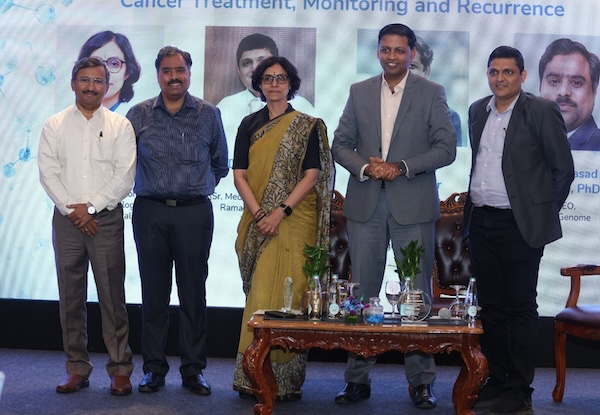
Unveiled in Bengaluru by oncologists Dr. Niti Raizada, Dr. Vinayak Maka and Dr. Rajeev Vijayakumar, along with Ramprasad Vedam, PhD, CEO, MedGenome Labs, the test is designed for patients previously diagnosed with cancer and enables longitudinal molecular monitoring through a repeatable blood test.
OncoTrack MRD uses an individual patient's tumour tissue to identify tumour-specific genetic signals, which are then tracked through circulating tumour DNA (ctDNA) in blood. Unlike tests based on a generic panel of mutations, the tumour-informed approach is designed to detect signals specific to each patient's cancer.
The test can be performed multiple times a year, as clinically appropriate, allowing clinicians to monitor changes in tumour DNA, assess residual disease and treatment response, and identify potential recurrence earlier. MedGenome said the test is available nationwide, with home sample collection intended to improve accessibility.
“Our personalised and ultrasensitive NGS based tumour-informed MRD test answers these questions by adding an important layer of molecular insight to complement existing clinical assessment and imaging,” said Vedam Ramprasad. He added that OncoTrack MRD reflects MedGenome's focus on making advanced precision oncology more affordable and accessible in India.
The test can be applied across a broad range of solid tumours, including breast, colorectal, lung, ovarian and other gynaecological cancers, pancreatic, oesophageal, gastric, hepatocellular and thoracic cancers, and melanoma. MedGenome highlighted patients with resected Stage II/III colorectal cancer, early-stage non-small cell lung cancer (NSCLC), and early or locally advanced breast cancer who have completed curative-intent treatment as particularly relevant populations.
The clinical rationale for tumour-informed ctDNA monitoring is supported by evidence from studies including the GALAXY study under the CIRCULATE-Japan programme, as well as the IMvigor011 and ADAURA trials, which have explored the role of ctDNA in recurrence detection, treatment monitoring and treatment decision-making.
Dr. Niti Raizada, Principal Director-Medical Oncology, Fortis Hospitals, said tumour-informed MRD testing could complement imaging by helping identify patients who may require closer surveillance or earlier intervention when microscopic disease is not yet visible.
Dr. Vinayak Maka, Senior Medical Oncologist, Ramaiah Memorial Hospital, said MRD testing could bring greater precision to monitoring disease that remains undetectable through conventional clinical assessment.
According to Dr. Rajeev Vijayakumar, Senior Consultant – Medical Oncology, Hemato-oncology and BMT Physician at Gleneagles BGS Hospitals, molecular-level monitoring provides clinicians with an additional layer of information on how a patient's disease is responding and evolving.

Subscribe To Our Newsletter & Stay Updated