Industry, policymakers focus on AI-led regulatory harmonisation, FTAs, MSME support and market expansion as exports touch $28.29 billion till February FY26
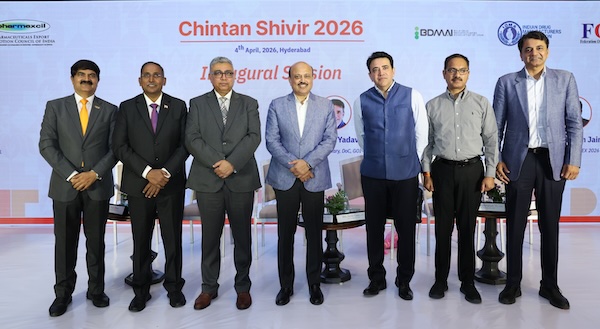
The Chintan Shivir on the pharmaceutical sector, organised by PHARMEXCIL with support from the Ministry of Commerce & Industry, concluded successfully in Hyderabad on Saturday, bringing together senior government officials, regulators and industry leaders to shape the next phase of India’s pharmaceutical export growth.
The Hyderabad edition continued the series of high-level industry consultations after earlier successful meetings in Chandigarh and Ahmedabad, with discussions centred on strengthening India’s position as a global pharmaceutical export powerhouse.
Chairing the inaugural session, Commerce Secretary Rajesh Agrawal said India’s pharmaceutical industry is well placed to consolidate its global leadership by deepening industry-government collaboration, reducing supply chain dependencies and moving towards higher-value segments such as biologics and biosimilars.
He emphasised that the next phase of growth would depend on reinforcing India’s credibility as a trusted global benchmark for quality, reliability and innovation, while leveraging digital transformation and regulatory alignment to improve global market access.
PHARMEXCIL Chairman Namit Joshi said the sector continues to remain resilient despite supply chain stress and geopolitical disruptions, adding that the Chintan Shivir created a focused platform to deliberate a forward-looking roadmap for the coming years.
He noted that the strategic vision emerging from the event is centred on value creation through innovation and wider market access through Free Trade Agreements (FTAs), backed by sustained policy support.
Highlighting the sector’s current momentum, PHARMEXCIL Director General Raja Bhanu said India’s pharmaceutical exports reached USD 28.29 billion during April–February FY26, registering 5.6% growth year-on-year, despite persistent global challenges. He added that the domestic pharma sector, currently valued at around USD 60 billion, is projected to grow to USD 130 billion by 2030.
Key sessions during the day focused on the impact of artificial intelligence and digital transformation on global harmonisation in pharmaceutical regulatory affairs, with experts discussing how digital tools can simplify regulatory workflows, strengthen compliance and accelerate access to overseas markets.
The deliberations also covered the role of the Export Promotion Mission in empowering MSMEs, the use of India’s FTAs to drive pharmaceutical exports, and the growing significance of DGFT’s Trade Connect e-platform in helping companies explore global opportunities.
Stakeholders further discussed strategies to enhance pharmaceutical exports through stronger regulatory compliance, wider market penetration and continued government support, underscoring India’s ambition to expand its global pharmaceutical footprint in the years ahead.

Subscribe To Our Newsletter & Stay Updated