The Union Minister noted that heat stress contributes to a rise in both communicable diseases such as dengue and non-communicable conditions like cardiovascular disorder
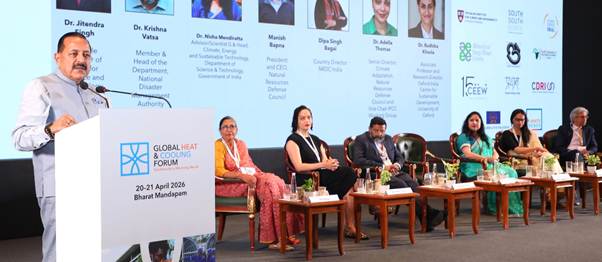
Minister urged stakeholders to move beyond dialogue toward actionable outcomes that address immediate challenges while aligning with long-term sustainability goals
India is accelerating its push toward sustainable cooling and climate resilience under the India Cooling Action Plan, now implemented across more than 250 cities, as rising temperatures increasingly impact health, the environment, and the economy.
Speaking at the inaugural plenary of the Global Heat and Cooling Forum, Dr Jitendra Singh, Minister of State (Independent Charge) for Science & Technology, Earth Sciences, and MoS PMO, Personnel, Public Grievances, Pensions, Atomic Energy and Space, highlighted that global warming is no longer just an environmental issue but a growing public health concern.
He noted that heat stress contributes to a rise in both communicable diseases such as dengue and non-communicable conditions like cardiovascular disorders, underscoring the need to integrate climate science with healthcare systems.
The forum, organised with participation from the Department of Science and Technology (DST), National Disaster Management Authority (NDMA), Coalition for Disaster Resilient Infrastructure (CDRI), and Natural Resources Defense Council (NRDC), brought together global experts to discuss sustainable cooling and climate adaptation strategies.
Singh emphasised that India’s diverse climatic conditions—ranging from extreme heat to extreme cold—require tailored, region-specific approaches rather than uniform global solutions. He also pointed to shifting disease patterns, with the country simultaneously facing tropical infections and lifestyle-related illnesses, both exacerbated by rising temperatures.
Highlighting behavioural aspects, the Minister noted that increasing dependence on artificial cooling has altered human adaptability, cautioning against excessive air conditioning due to its impact on energy demand and environmental sustainability. He stressed the importance of equitable access to cooling solutions to prevent widening social disparities, while also advocating responsible consumption practices such as optimal temperature settings.
Concluding his address, he urged stakeholders to move beyond dialogue toward actionable outcomes that address immediate challenges while aligning with long-term sustainability goals.

Subscribe To Our Newsletter & Stay Updated