Developed by the Sudha Gopalakrishnan Brain Centre, the publicly accessible ANCHOR atlas maps over 200 brainstem structures at cellular resolution, offering new possibilities for neuroscience research and clinical applications
Developed by the Sudha Gopalakrishnan Brain Centre (SGBC) at IIT Madras, the new resource, called ANCHOR (Atlas of Neurochemical Characterization of the Human Brainstem with 3D Reconstruction), provides the most comprehensive multi-modal 3D maps and atlases of the human brainstem created to date.
The atlas spans developmental stages ranging from the prenatal period to childhood and adulthood.
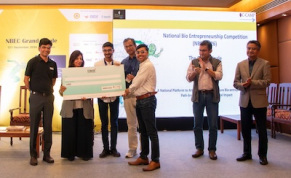
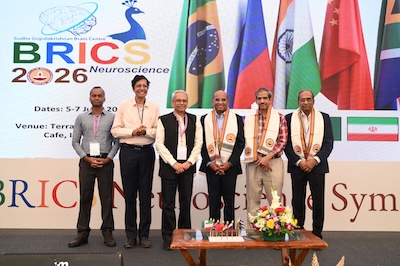
Released during the 3rd BRICS Neuroscience Symposium 2026 held at the IIT Madras campus, ANCHOR has been made publicly accessible to researchers, clinicians, and healthcare professionals worldwide through an online platform, enabling broader scientific collaboration and discovery.
The atlas contains detailed reconstructions of more than 200 brainstem nuclei and fiber tracts generated from hundreds of serial brain sections. Researchers combined eight complementary immunostaining techniques across more than 500 sections to identify and map distinct neurochemical cell populations with unprecedented detail.
The atlas was released in the presence of Ajay Kumar Sood, Principal Scientific Adviser to the Government of India, who described the project as a landmark achievement in neurobiology.
“This is a significant accomplishment in the field of neurobiology. It will be the most detailed and comprehensive maps of the human brainstem and made available publicly in digital form. These maps will help in identifying specific cell populations affected in brain stem lesions which could be critical for clinical applications,” he said.
According to V. Kamakoti, Director of IIT Madras, the initiative places the institute at the forefront of efforts to understand one of the most complex structures known to science—the human brain.
“I always take pride that at IIT Madras we are exploring a lot of things but this particular exploration puts IIT Madras in the frontiers of the most complex creation that this world has witnessed - the human brain,” he said, adding that the centre is also studying brains affected by diseases such as dementia, Alzheimer’s disease, and rabies to better understand disease-related structural changes.
Kris Gopalakrishnan, whose philanthropic support has played a key role in the development of SGBC, praised the researchers for making the atlas openly accessible.
“I hope this will make important contributions to neuroscience in the world. In India, we have the awareness of affordable science and affordable technology because ultimately technology must serve society and the people. Accessibility, affordability and inclusiveness are very important,” he said.
Highlighting the technological innovation behind the project, Mohanasankar Sivaprakasam said the atlas integrates macro-scale MRI data with micro-scale cellular imaging, enabling researchers to seamlessly navigate from large brain structures down to individual cellular features.
“We envision that these maps and atlases will have significant implications for neuroscience and neuromedicine. This is an important scientific milestone for the Centre and is a big boost as we pursue our mission of imaging over 100 whole brains across the human lifespan and neurological diseases,” he said.

Subscribe To Our Newsletter & Stay Updated